Capital: Case study blog tasks
Capital: Case study blog tasks
Work through the following tasks to build a detailed case study for Capital. This will give you plenty of background information to use in an exam question. Remember, for this CSP the question could be on any of the key concepts: language, industries, audiences or representations.
Reviews and features
Read the following review and feature on Capital:
Guardian review by Sam Wollaston
London Evening Standard: five things you need to know about Capital
1) What positive points does the review pick out about Capital? What criticisms are made - either of the TV drama or the original novel?
Work through the following tasks to build a detailed case study for Capital. This will give you plenty of background information to use in an exam question. Remember, for this CSP the question could be on any of the key concepts: language, industries, audiences or representations.
Reviews and features
Read the following review and feature on Capital:
Guardian review by Sam Wollaston
London Evening Standard: five things you need to know about Capital
1) What positive points does the review pick out about Capital? What criticisms are made - either of the TV drama or the original novel?
It’s not just a brilliant allegorical portrait of London. There are stories to tell, the postcards keep coming, then DVDs, someone really WANTS WHAT THEY HAVE. It shows that London itself, has cancer – a tumour of greed, and mistrust, hatred and pointlessness. The location is also positively recognised as easily/ "instantly recognisable". The narrative is seen as "more interesting than just wonderful and terrible" as it allows the audiences to pick and choose which characters from the ensemble cast they sympathise for and which they don't.
2) What references can you find in the reviews and feature to the idea Capital is a 'state-of-the-nation' drama? How does it capture modern-day London?
2) What references can you find in the reviews and feature to the idea Capital is a 'state-of-the-nation' drama? How does it capture modern-day London?
That "it's not just a brilliant allegorical portrait of London" and it demonstrates an "instantly recognisable" setting not only due to London being the heart of the narrative but due to the fact that they "have managed to squeeze an incredible amount into one street" within the capital city (London).
Trailer analysis
Watch the trailer for Capital:
1) How does the drama use camerawork to capture London life?
Trailer analysis
Watch the trailer for Capital:
1) How does the drama use camerawork to capture London life?
Firstly, at the beginning of the trailer there is a crane establishing shot of the whole urban landscape within London to provide an image of how the whole city looks for the audience as the main narrative is all happening in one street. The street name "Pepys Road" is then shown in a low angle close up to show how the street holds power within a diverse community and all events are about to take place there. There is then a long shot capturing the street itself to show it's importance within the story line, followed by a montage of different medium shot clips of each of the main characters from the ensemble cast. There are then also many low angle shots of the letterboxes in those peoples houses while a letter is being slipped through, which identifies the dominant impact these letters are going to have on each of the characters as they are the centre of the plot.
2) How does the trailer introduce the different narrative strands suggesting tension or enigma in the 40-second running time?
There is a range of close ups of the letters, with addresses written on them for the same street each time to link the street with the letters in order to develop the narrative and give audiences an enigma code to follow through on watching the TV drama, by keeping them hooked on this sense of mystery and suspense as the rhythmic ticking sound is designed to gather suspense, while repeating patterns to subconsciously increase tension and anticipation.
Capital in Media Magazine
Issue 83 of Media Magazine has a feature exploring Capital as a media product. Read ‘We Want What You Have’ in MM83 (p10). You'll find our Media Magazine archive here - remember you'll need your Greenford Google login to access. Answer the following questions:
1) What does the article suggest about the 'state of the nation' genre and how Capital is an example of this?
It says that the drama is based off a "state of the nation" novel and such novels try to represent an entire
country at a particular moment in time. As such, they involve multiple story lines and a large cast. Despite being
restricted to four episodes, Capital has a large ensemble cast and features multiple story lines pertinent to its 2007/8 setting. As its title suggests, the action takes place in the melting pot of the UK’s capital, London. Specifically, it focuses on characters with links to Pepys Road (Samuel Pepys, of course, being a great 17th century state-of-the nation London diarist). With a population of almost 9 million people, speaking about 250 languages, clearly no single text is going to encapsulate the reality of London, let alone the nation. That’s what makes the selections made in terms of characters and story lines so interesting to explore further.
2) What does the article suggest regarding the setting of Capital?
Centring the action on a single street in London helps bring some focus to the narrative. This is demonstrated in establishing shots at various points in episode one. Aerial shots of large chunks of the city zoom in to smaller segments, before zooming in on Pepys Road in particular, and then a single house or character. This makes sense in the context of a multi-stranded production.
3) What are the major themes in Capital and what does the article suggest regarding the impact of money on communities?
Thematically, it seems that money is breaking up the community and, by extension, breaking up social bonds up
and down the country. The opening sequence foregrounds this sense of disharmony. A hooded figure stalks Pepys
Road at night, taking photos of front doors and bedroom windows. Later, the photos are pushed through residents
letterboxes on postcards in a seeming campaign of terror. Alongside them are the words WE WANT WHAT YOU HAVE. This suggests themes of terror and communism arising from the dark.
4) What different representations in Capital are discussed in the article?
The representations of good versus bad, rich versus poor and industrious versus feckless make for straightforward
drama. Also, it’s easy to see why a banker would play a central role in a state-of-the-nation drama set at this time, given the massive impact of the financial crash in 2008. However, this drama subverts racial stereotypes by portraying the lives of a diverse community slowly coming together. Furthermore, while Ahmed is portrayed
as friendly and helpful, his family’s narrative still involves Islamic fundamentalism and clearly fails the ‘Riz test’. One of his brothers makes anti-Western comments, and his other is visited by a man called Iqbal, who is shown furtively using a laptop, presumably linked to terrorist activities.
5) What does the final section of the article suggest regarding genre and overall message of the drama?
Capital's opening sequence draws on the crime genre. The shadowy hooded figure, mentioned above, is shot in grainy, handheld footage. Their presence sets up an enigma, with a series of questions to be resolved. Framing a state-of-the-nation drama with this crime element helps to hold the viewer’s attention. But it also has an artistic purpose. All of our lives are framed by a hidden, sinister force, one that the drama clearly identifies as capital (in the money sense). They also say that Capital positions the actions of the banks as criminal. So hidden are their activities, so complex and difficult to track down, that a straightforward state-of-the nation drama could not possibly hope to cover them adequately. But it can try and expose them in other ways. The shadowy figure in episode one comes across not so much as a criminal as a Banksy-style urban artist. This is particularly apparent in the closing shot. The camera zooms out to show the street in its entirety. The words ‘WE WANT WHAT YOU HAVE’ have been written in red along the entire length of the road. If the state-of-the-nation is in some ways unseen, perhaps the job of the artist is to make it clear. Perhaps that is just what Capital is trying to do.
Capital Media Factsheet
Use our Media Factsheet archive on the M: drive Media Shared (M:\Resources\A Level\Media Factsheets) or on Google Drive here (you'll need your Greenford Google login) to find Media Factsheet #194 on Capital (BBC TV Drama).
Read the whole of Factsheet and answer the following questions:
1) What does the factsheet say about the characters on the first page?
The multi-stranded narrative is explored through the different residents. The characters also demonstrate the state-of-the-nation aspect of this drama. Episode 1 focuses on Petunia Howe (no. 84) and Roger and Arabella Yount (no. 92). We are also introduced to the Kamal family, who run the corner shop, and Quentina Mkfesi, a religious asylum seeker with a PhD working illegally as a traffic warden. The interactions between the characters reflect the tensions between different cultures and costume is used to quickly communicate the different character roles.
2) Focusing on the industrial contexts, how does Capital help the BBC meet its obligations as a public service broadcaster?
Capital was produced for the BBC, and fulfils the requirements of a public service broadcaster. The BBC are primarily funded by the licence fee, and has a set of values and public purposes that govern the content that is produced. Fundamentally the BBC seek to educate, inform and entertain. Capital meets these terms through provision of UK cultural information surrounding the wealth dynamic as well as issues with immigration, ageing and more. They also entertain with the mystery narrative following the episodes of a figure stalking the ensemble cast on the same street.
3) What do we learn about the ownership structure for production company Kudos?
The ownership of Kudos reflects a horizontally integrated company. The parent company, Endemol Shine UK, own a range of TV production companies across different formats and genres. Endemol Shine UK is owned in equal share by Apollo Global Management (an American public equity firm) and 21st Century Fox. 21st Century Fox is owned by the Murdoch family, and was established in 2013 as a spin-off for the film and TV aspects of News Corporation. News Corporation was split following a series of scandals in British press.
4) How can David Hesmondhalgh's ideas in The Cultural Industries be linked to Capital and Kudos?
It shows that Kudos is financially dominant in the market because they use horizontal integration to promote power. Additionally, Capital also promotes financial power and a capitalist city of London, which can be seen through the power and wealth dynamic between working class migrants and middle class British citizens. This links to how Hesmondhalgh talks about big conglomerate companies owning the marking and having higher share and power than smaller companies.
They suggest that Capital meet these key genre conventions that crime and social realism portray:
Conventions of crime genre
• Use of narrative enigmas.
• Restricted narrative.
• Resolution of a mystery.
• Question of morality.
• Debates around innocence and guilt.
• Verisimilitude – representations of ‘ordinary’ people in
everyday life are recognisable to audience.
• Power struggles (within different divisions of police or
within community).
• Teamwork and pleasures in successful resolutions.
• Corruption and betrayal often key theme within a
narrative.
• Villainy is evident through the characteristics of various characters.
Conventions of social realism
• Strive to represent regions of UK with authenticity.
• Narratives explore social issues (such as economic inequalities/immigration/Islamophobia).
• Triumph over adversity.
• Shooting on location to offer authenticity.
• Wide shots used to establish the location and setting as this is often key to understanding the narrative and themes.
• Humour and seriousness intertwined in a narrative.
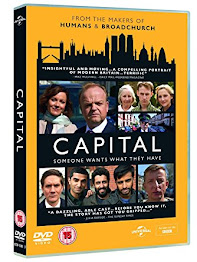
6) How does the factsheet analyse the DVD packaging and what this communicates to the audience?
The DVD cover uses the same promotional images that feature in media pack, website and press coverage. This
creates the recognisable brand for the audience. The silhouette skyline of London contains clear geographical
markers that denote the setting, and also establish the themes of British culture and financial issues (as both the
Houses of Parliament and the Gherkin are featured). The reference to Kudos’ previous productions serves to give
credibility to the TV drama and is designed to appeal to audiences who may not be familiar with the BBC (this
DVD can be purchased globally). The layout of the characters on the cover carries a connotation to the crime
drama, with medium close-up shots of DI Mills, The Kamal family and Bogdon. The inter-textual reference to
a mug shot is evident here, and gently hints at the crime genre. The colour, however, seeks to draw the audience away from a stereotypical crime drama and as yellow is not associated with crime, but instead moves towards the contemporary state of the nation representation. The quoted reviews anchor this representation for the audience. The images on the cover all break the 4th wall, and seek to engage the audience. The inclusion of a tagline, ‘someone wants what they have’, offers a final enigma code to establish the disruption within the narrative.
7) Look at page 5 of the factsheet. Choose one of the audience theories in the table and apply it to Capital.
Uses and Gratifications - DVD:
There is an ensemble cast in the, which showcases a diverse group of characters all from different background and social classes, which allows personal identity to be shows as all the different members of the audience can relate to at least one of the characters from the wide cast range. Additionally, there is a landscape silhouette image of the city to provide diversion and a sense of surveillance as the heights of each building varies just like the life of each character does so this may, apart from entertainment, also provide some information towards London's urban landscape involving multiple styles as the place is becoming diverse. They can also produce personal relationships with their favourite characters from the large choice provided by the ensemble cast.
8) What does the factsheet suggest regarding binary oppositions in Capital?
The multi-stranded narrative uses binary oppositions throughout to highlight the difference or inequality in Pepys Road, and then raise questions about inequality in London more widely. The character of Roger Yount is a clear example of this. During his own narrative development, we see binary oppositions within his own character (the money driven banker starts to yearn for a life with more meaning). We also see the financial inequalities through Roger and Arabella. Their initial highly stereotyped dialogue (“How do you feel about cedar wood cladding?”) serves to position the audience to understand the change in society and the Pepys Road community from ‘normal’ residential street to million-pound properties. The binary oppositions serve an insight into the dynamic wealth statuses in London as well as the power and gender inequality.
Representations: close-textual analysis
Capital offers a range of fascinating representations - from London and asylum seekers to capitalism and inequality. You need to be able to confidently discuss these issues in the context of 2015 London - with reference to key scenes from episode 1. Representations include: London, family, gender, ethnicity, religion, immigration, asylum, inequality, wealth, capitalism, ageing and more.
These are our notes from this year analysing the episode in class. There are also these notes from a previous year analysing the clips in case this is useful. Use this to help with this element of the case study. You'll need your Greenford Google login to access the document.
1) Write an analysis of the representations in each of the key scenes from episode 1 we studied in the lesson:
Scene 1: opening sequence 00:30 – 4.49
1) Write an analysis of the representations in each of the key scenes from episode 1 we studied in the lesson:
Scene 1: opening sequence 00:30 – 4.49
- There is a birds eye view looking down at the city of London, which is represented by one street in the urban area. This also creates enigma codes due to the multiple stories linking to crime and action within the wealthy street, filled with different lifestyles.
- The shopkeeper is a businessman, while his wife takes care of the children and acts as a housewife, reinforcing traditional gender roles in patriarchy. The man in the flashback was a breadwinner to the old lady who was also just a housewife in the montage flashback sequence, again reinforcing traditional norms.
- South Asian family struggle to balance duties with boundaries as they sell magazines in which women are sexualised, which is seen as immoral but also it's a good seller so the working class migrants sell it still for the profit even though it goes against the morals formed by their religion. There is also normalisation of multicultural living as people from diverse backgrounds communicate in everyday life.
- Ageing is issued with isolation, which brings nostalgia for the old lady who had the flashbacks of her husband who died, which also causes her fear of dying alone. Additionally, immigration had positively changed some aspects in society, causing normalised diversity in society. However this has also allowed culture clashes to cause difficulty within modern living.
Scene 2: work in the City 6.28 – 8.10
- Wealth is portrayed through the view of many offices and buildings in the city, which is contrasted by Roger's commute to work as he takes the underground public transport (train). There's another birds eye view of the city to showcase professionalism and significant financial places. The busy overcrowded public transport in London is a binary opposite to the empty and sparse banking building, in which Roger works.
- There are mostly only men in the banking building, which reinforces gender stereotypes of male dominance, suggesting men should be out doing hard work and building a high status reputation, while their wives stay home as housewives. The scene where Roger is dancing after hearing there is a £1 million bonus at work subverts traditional norms of male dominance as it shows a city banker acting unserious.
- You can see that people of a white background are working middle class jobs that maintain their wealthy status such as banking like Roger, unlike the jobs that migrants are working. London is filled with male upper middle class workers, however there is diversity in nationality as Roger's boss is German, just not in class.
- Roger looking over London from his office symbolises the dominance of the capitalist ideology in the city as everyone is fighting for their own success and wealth.
Scene 3: “Which of those isn’t absolutely essential?” 14.00 – 15.35
- London is a space of extreme wealth but with underlying anxiety, as shown by the one million pounds being insufficient for Roger and his wife due to the high economic crisis in London. London is also shown as a surveilled and exposed city which lacks privacy, shown by the mystery figure taking photos without consent, and it's also socially fragmented and multicultural.
- Marriage is framed through financial negotiation, as seen by Rogers' marriage, and his wife challenges him, which subverts traditional stereotypes surrounding women being obedient. This shows that his wife has more control and authority in their relationship and family. Roger is seen as insecure about finances, which undermines traditional masculine stereotypes of financial dominance and male power. There are also generational differences as the youth prioritise connection, as seen by the roommate who texted Sophia, whereas elders who are middle-aged seek financial security, which is their main priority.
- There is normalised multicultural coexistence shown through the two roommates being white and Pakistani, which shows integration and everyday multicultural. Whiteness is aligned with romantic freedom as the white roommate is texting Sophia, which reflects ease and personal freedom with no cultural restriction of financial anxiety as migrants face a social burden, which reinforces stereotypes that previously allowed white people to block out this social burden.
- In terms of aging, the older you are, the more your priorities shift towards financial security and more pressure faced. Wealth is not security as it becomes another source of stress and property wealth makes residents targets, which is shown by the mystery guy who took photos and it links back to the whole idea of the quote, we want what you have. Additionally, London's economic system creates insecurity as there is economic disparity due to the crosscut from one million pound homeowners to flat sharing young adults.
Scene 4: asylum 18.03 – 19.42 AND 31.10 – 32.40
- London is seen as economically exploitive as £200 symbolises survival wages in the city compared to a £1 million bonus for British citizens. It shows that London is morally divided within ideologies of capitalism versus spirituality, and this causes economic pressures as London is seen as globally rich but internally unequal. Furthermore, the office setting in the other scene shows that London is a city of systems and authority, and it's not automatically welcoming and requires documents and approval, so belonging is controlled by institutions.
- There is much male dominance as the black man blackmails Quentina and increases his own commission out of her wage. He also sexualises the woman who has to accept in fear due to immigration hierarchies as well as gender hierarchies. Furthermore, there is female vulnerability as her uniform suggests a lower economic status. and reinforces class positioning. Both women at the table are female members of society, but there is still a power imbalance due to authoritative figures.
- Quentina is seen to be going to church, which shows collective belonging overpowering isolation. She is also seen as morally centred and spiritually grounded, and the transition to the church positions Christianity as a source of emotional strength. Within the office scene, identity is seen to need justification, as Quentina is seen as a case, not a person, which emphasises racialised border control.
- Quentina is at risk of being deported and vulnerability is seen surrounding immigration. The £200 symbolises financial struggle that migrants face, especially those with insecure legal Statuses who are blackmailed. There is also power imbalance as she can't challenge the injustice openly and there is much class inequality on the same street, which has binary opposition of £200 versus £1 million. Furthermore, her right to remain in London is dependent on official approval, which shows that she contributes to society as her job is a public-serving role without actually belonging there. And the desk in the office scene symbolises the thin line between staying and deportation for Quentina.
Scene 5: “What use is 30 grand?” 36.40 – 39.00
- London is seen as a high-pressure financial environment full of capitalist stress, wealth, and performance-dominating social interactions. This frames the city as a place where financial sums are constantly evaluated and judged, and private stress is amidst public professionalism. For example, Roger pukes in the private stall in the bathroom and sits casually in the park, showcasing London as an economically stratified city where money controls relationships.
- Masculinity is under strain as Roger is visibly overwhelmed by financial pressure, subverting traditional patriarchal stereotypes. The failure triggers vulnerability for Roger, and he shows anxiety within the male workplace as he is unable to provide for family, and his age and identity is tied to his wealth and status. As an addition to his anxiety, family expectations cause much pressure.
- White British professional middle-class man, in brackets, Roger, represents traditional professional demographics of London. Privilege is contextualised as Roger has an access to an office and wealth, unlike migrant characters. Religion is unmentioned and the representation of ethnicity is tied to socioeconomic professional positioning.
- Wealth and psychological pressure is critiquing capitalist ideology. Financial stress causes physical pain, such as frustration and vomiting, and the city demands appearances while concealing personal struggle. Middle-aged responsibilities cause fear of losing competence, and there is much inequality and emotional instability in society.
Scene 6: life at the corner shop 40.10 – 42.55
- There is a classic urban London setting which shows multicultural living and small local businesses serving the community. Domestic life exists alongside global finance in everyday spaces. This grounds the narrative in ordinary domestic needs which reinforces the realities of daily living of Londoners.
- Roger's wife is shown attending to household needs, such as buying parsley, showing her care for family meals and portray the housewife role traditionally. The shopkeeper, the business owner, is male and is reinforcing gender roles as he is working as a businessman, showing male dominance. There is domestic labour and gender division, and the brothers arguing at dinner is normalised, as well as the burden of male responsibility, which causes conflict and tension.
- The shopkeeper is from ethnic minority backgrounds, common in corner shops, and there is normalisation of multicultural, polite encounters without conflict and drama, which subverts racial and ethnic divide. London's diversity is embedded in routine and ordinary, as well as unproblematic.
- Ageing and domestic routine in middle-aged women shows small necessary tasks done to maintain the domestic lifestyle. There is economic inequality, as they are struggling to provide basic meals for their migrant family. As shown by the Pakistani shopkeeper, migrants experience day-to-day pressures, and migration is tied to survival responsibility and intergenerational stress.
You can choose which aspects to focus on for each scene: e.g. London, family, gender, ethnicity, religion, immigration, asylum, inequality, wealth, ageing etc. Feel free to use bullet points for each scene - a summary of your notes is fine.
2) How does Capital use stereotypes? Do the characters and issues represented in Capital reinforce or subvert the stereotypes we typically see in the media?
2) How does Capital use stereotypes? Do the characters and issues represented in Capital reinforce or subvert the stereotypes we typically see in the media?
I think capital subverts most stereotypes especially those surrounding gender as well as race and ethnicity as we see multiple characters that hold power against traditional norms. For example, Roger's wife is seen as more dominant and in control, choosing to leave the house whenever she likes even by herself at night, which would be considered unsafe in a patriarchal society. Furthermore, she also causes fear and anxiety in her husband. Also, in the immigration office, the woman speaking to Quentina was black, and although they were of the same race, the officer had more power than Quentina. Additionally, Quentina serves the public with her role as a traffic officer, which would traditionally be seen as a male role. However, there are some scenes that reinforce traditional stereotypes about gender as scene by the scene where the man only gives Quentina £200 and takes the rest of her wage as commission, which she had to silently accept as he blackmailed her, reinforcing male power in society.
Industries and production context
Capital was produced by independent production company Kudos for the BBC. Look at the Kudos website and also read the Kudos Wikipedia page.
1) Who is the parent company for Kudos? What changes of ownership have there been for Kudos? This is an example of conglomerate ownership.
Capital was produced by independent production company Kudos for the BBC. Look at the Kudos website and also read the Kudos Wikipedia page.
1) Who is the parent company for Kudos? What changes of ownership have there been for Kudos? This is an example of conglomerate ownership.
The parent company is Banijay UK, which is a subsidiary of the Banijay group.
Kudos has undergone several changes of ownership, moving from an independent production company to becoming part of larger media structures:
Independent (1992–2006): Formed in 1992 by Jane Featherstone and Stephen Garrett.
Shine Group (2006–2011): In late 2006, Kudos was sold to Shine Limited (founded by Elisabeth Murdoch) for approximately £35 million.
News Corporation (2011–2014): In 2011, News Corporation acquired the Shine Group, making Kudos part of a global media conglomerate.
Endemol Shine Group (2015–2020): Following a merger, Shine Group became part of a 50-50 joint venture between 21st Century Fox and Apollo Global Management, known as the Endemol Shine Group.
Banijay Group (2020–Present): On July 3, 2020, France-based Banijay acquired the Endemol Shine Group, bringing Kudos under the Banijay UK umbrella.
2) Watch the showreel on the Kudos website. What other TV dramas have Kudos produced and for which channels? What awards have they won?
Other TV dramas that they have produced, especially in the crime genre are Grantchester (ITV), Broadchurch (ITV), Life on Mars (BBC One), Ashes to Ashes (BBC One), Deadwater Fell (Channel 4), Law & Order: UK (ITV). They have won the BAFTA television awards multiple times, international Emmys, Peabody awards and they were named Best Independent Production Company in 2007 and Best Indie (2016, 2018).
3) How does Capital help the BBC to fulfil its remit as a public service broadcaster? You may want to look back at our work on public service broadcasting last term.
Again, Capital was produced for the BBC, and fulfils the requirements of a public service broadcaster. The BBC are primarily funded by the licence fee, and has a set of values and public purposes that govern the content that is produced. Fundamentally the BBC seek to educate, inform and entertain. Capital meets these terms through provision of UK cultural information surrounding the wealth dynamic as well as issues with immigration, ageing and more. They also entertain with the mystery narrative following the episodes of a figure stalking the ensemble cast on the same street. This drama is available to watch on the BBC for free as long as the license fee is paid.
Comments
Post a Comment